Some days you want yoga that gets you moving, builds strength and leaves you energised. Other days you want something slower. A stretch, a bit of stillness, a chance to unwind.
What you want from yoga can change depending on what’s going on in your life. That’s one of the things I love about it. There’s no single way to practise and no one-size-fits-all approach.
Fire sounds powerful. Water sounds cool. Air feels free.
Earth? It’s quieter. Solid. Steady. It holds everything up.
That’s why it matters so much.
Over the past few weeks in our yoga classes in Rugby, we’ve been learning about Earth, or Prithvi (say: PRITH-vee). We’re not pretending to have roots in our feet. We’re learning about being stable, strong, and grounded.
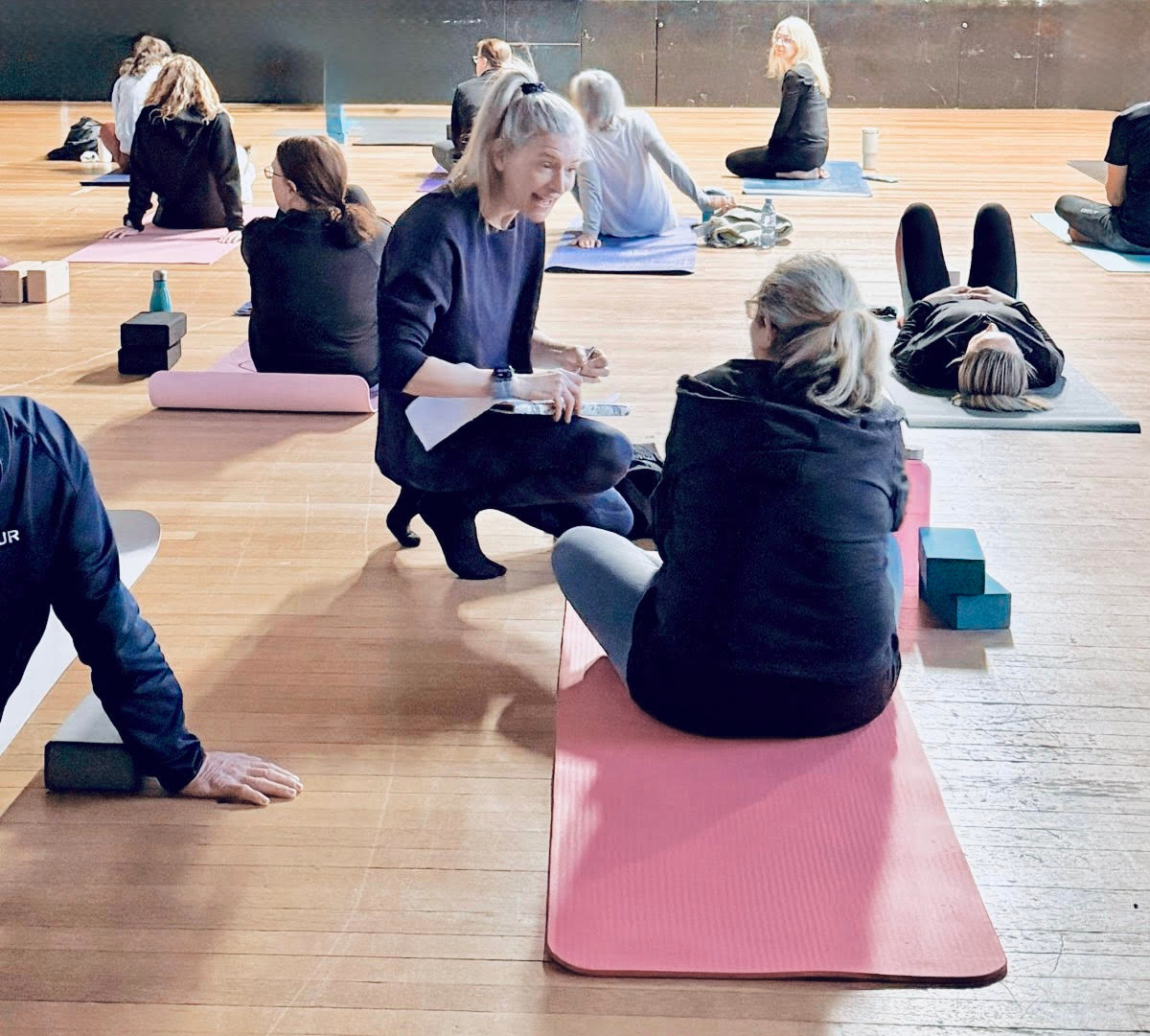
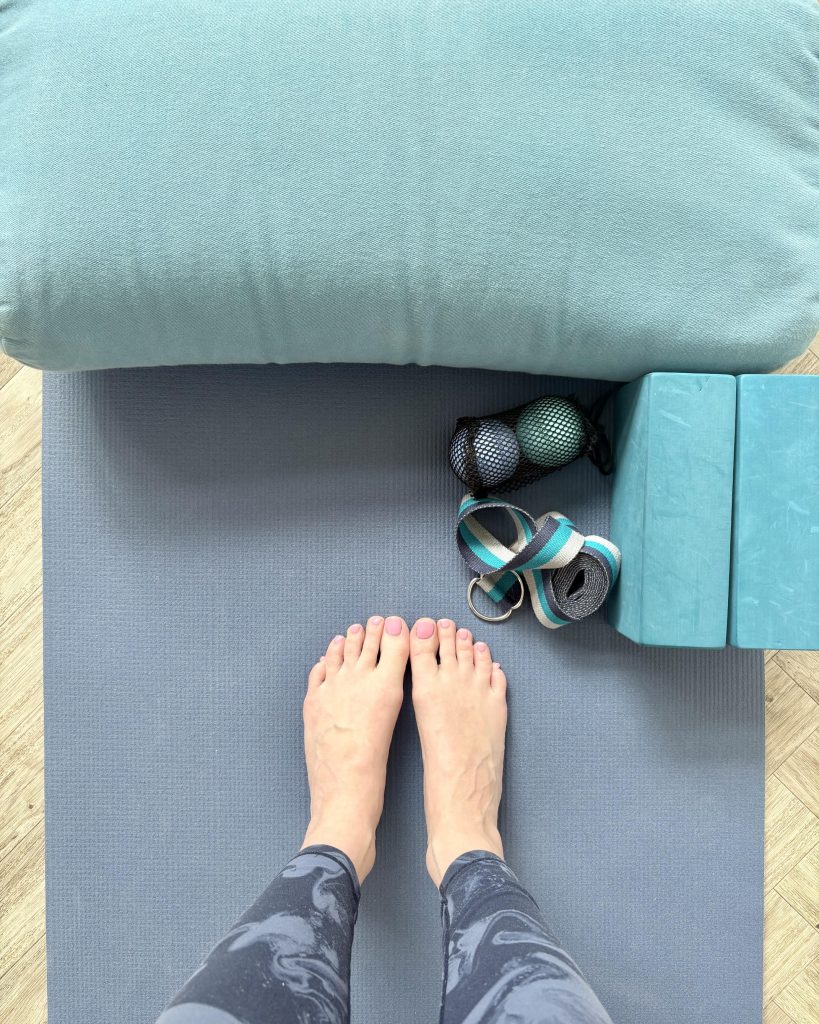
If you’ve used massage balls in one of my classes, you’ll know that something so small can make quite an impression!
We might place a ball under a foot, around the hips or behind a shoulder. Then we add a little pressure, perhaps a small movement, and notice how it feels.
This is self-myofascial release, often shortened to “Myo” in my classes. It sounds complicated, but it’s a form of self-massage.
What is fascia?
Imagine a three-dimensional spider’s web running throughout your body.
That gives you a rough picture of fascia, a network of tissue that connects and supports different parts of you. It surrounds and runs through muscles, and helps hold other structures in place.
It also separates neighbouring parts so they can slide alongside one another when you move.
Some fascia is thin and delicate. Other parts are thicker and stronger. It contains nerves that help you sense movement and pressure, too. So it does much more than hold everything together.
Fascia is involved whenever you move, whether you’re walking, stretching, lifting shopping bags or rolling out your yoga mat.
What does “myofascial release” mean?
“Myo” means muscle. “Fascial” refers to fascia.
Muscles and fascia work together. Think of an orange: little juice sacs sit inside segments, with layers holding the different parts together. Our muscles have layers of connective tissue around their smaller parts and around the whole muscle.
In class, we use massage balls to apply pressure to these soft tissues. You might rest against a ball, roll slowly or add a small movement.
You control the pressure. You can use less body weight, move the ball or stop whenever you need to.
Despite the word “release”, we aren’t trying to break anything apart. Researchers are still working out exactly how it helps. Part of the effect seems to come from how our brain and nerves respond to pressure and stretch. Movement may feel easier afterwards, without anything needing to be “unstuck”.
How can it help?
It can help you move more freely. It can improve how far a joint moves. Regular practice may also improve flexibility over time. That might mean a little more ease when bending or reaching.
It may ease soreness after exercise. It can help with the muscle soreness you sometimes feel after a demanding or unfamiliar workout. It’s one way to support recovery, alongside rest and a sensible balance of activity.
It may make a stretch feel more comfortable. Sometimes we can move further because the stretch feels easier to manage. That doesn’t always mean the tissues have become physically looser. Our brain and nerves play a part too.
There’s another reason I enjoy teaching it: it gives us time to notice our bodies.
Are you holding your breath? Have your shoulders crept up? Are you pressing harder than you need to?
Once you notice, you can adjust. You’ll probably still hear me reminding you to unclench your jaw!
Does it need to hurt?
No. Stronger pressure isn’t the goal.
It’s tempting to find a tender spot and think, “That must need extra work!” But there’s no need to grit your teeth or hold your breath.
Start with manageable pressure. Take a little time to see how it feels, without continually searching for a stronger sensation.
You can use put less weight on it or work on a blanket or against a wall instead of the floor. You can also stop. Staying longer isn’t automatically better.
Sharp pain, tingling or numbness are reasons to stop. Avoid pressing directly onto bones, joints or a fresh injury. If you have an injury or health condition that could make pressure unsuitable, check with your healthcare professional first.
Why combine it with Yin yoga?
A massage ball focuses pressure on a small area. A Yin posture offers a broader stretch.
We might work around the hips with a ball, then settle into a supported Yin posture and notice how it feels.
Is the movement easier? Does the stretch feel different? Would a cushion or block help you get comfortable?
I enjoy teaching them together because they offer different ways to work with the body and notice what changes.
Neither needs to be intense. A modest stretch or a little pressure can give you plenty to notice.
Some evenings, you don’t need to push yourself or do more. You just need a bit of space to slow down and let the day settle.
That’s why I’m introducing a Weekly Wind Down class – a new mellow Thursday evening yoga class at Houlton School in Rugby.
A calmer kind of yoga class
Weekly Wind Down brings together slow, gentle movement, simple yoga postures, calming breathwork and relaxation.
We’ll take our time, so there’s space to notice how you feel rather than rushing from one posture to the next. There’ll be options throughout, so you can adjust the practice depending on what your body and energy need that evening.
You don’t need to be flexible or have any previous yoga experience. There’s no pressure to keep up, reach a particular shape or get anything “right”.
Just come as you are.
Who is Wind Down for?
Wind Down could be a lovely fit if you’re new to yoga and want a gentle way to begin, or if you’d prefer something slower and softer than a Flow class.
Perhaps you find it difficult to switch off in the evenings, you’re returning to yoga after some time away, or you simply want an hour in your week that’s just for you.
This class is about moving in a way that feels good, letting go of some of the tension you’re carrying and gradually slowing down.
Is it the same as Yin Yoga?
Not quite.
Yin Yoga is mostly floor-based, with postures held for several minutes at a time. Wind Down includes more movement, flowing gently between simple postures before easing into relaxation at the end.
Think of it as sitting between my Flow and Yin classes: softer than Flow, but with more movement than Yin.
Wind down the week
By Thursday evening, the busiest part of the week is nearly behind you, even if your mind hasn’t quite caught up yet.
Wind Down gives you a proper pause before the weekend begins. It’s somewhere to put everything down for an hour, move gently and shift into a slower pace.
You can leave feeling calmer, more settled and ready to enjoy the weekend ahead, rather than spending it recovering from the week.
Class details
When: Thursdays, 6.00–7.00pm, starts 5 November. Where: Houlton School, Rugby Level: All levels, complete beginners welcome. Price: £8 per class when booking the block.
If you’ve been thinking about trying yoga but haven’t been sure where to start, or you’d simply like a softer practice towards the end of the week, Wind Down could be just what you need.
If you’ve spotted Lifted on my timetable but wondered what we actually do for two and a half hours, this is for you.
Perhaps you’re wondering whether it means two and a half hours of continuous yoga, whether you’ll be able to keep up, or whether you’ll manage to switch off for that long.
The short answer is that you won’t be moving for the whole session. Lifted Reset gradually takes you from unhurried movement into stillness, with time for your body and mind to settle at each stage.
My next Lifted afternoon is on Saturday 26 September at The Barn in Houlton. There is another chance to join me on Saturday 19 December.
By March, I’m usually ready for the lighter mornings and the first signs of spring. But that doesn’t always mean my energy has caught up.
Late winter can feel like a bit of an in-between time. The darkest months are beginning to ease, but we may still feel tired, stiff or in need of warmth. It can be tempting to rush straight into spring and start doing more, when perhaps what we really need is a little time to rest, move and slow down before we speed up again.
Summer has a way of filling every corner of your life.
The diary gets full before you’ve even noticed. Holidays, family plans, school holidays, social things, late nights, garden jobs, weekends away. And somewhere in the middle of all of it, you.
It can be wonderful. It can also leave you running a little empty.
So if you’re already sensing that you’ll need a proper pause once summer is over, this is your gentle reminder to book something in now, while it’s on your mind. Not because you need to earn rest, but because it is so easy to leave yourself until last.
Come and spend a day with me this October.
Release + Replenish s an autumn yoga day retreat I’m hosting at the beautiful Cowslip Meadows in South Leicestershire.
It has been designed for that point in the year when the brightness of summer begins to fade, the evenings start drawing in, and your body quietly starts asking for something slower.
This is that something.
A full day away from the noise of everyday life. Time to soften what has built up, restore your energy, and ease into the final months of the year feeling more like yourself again.
Where we’ll be
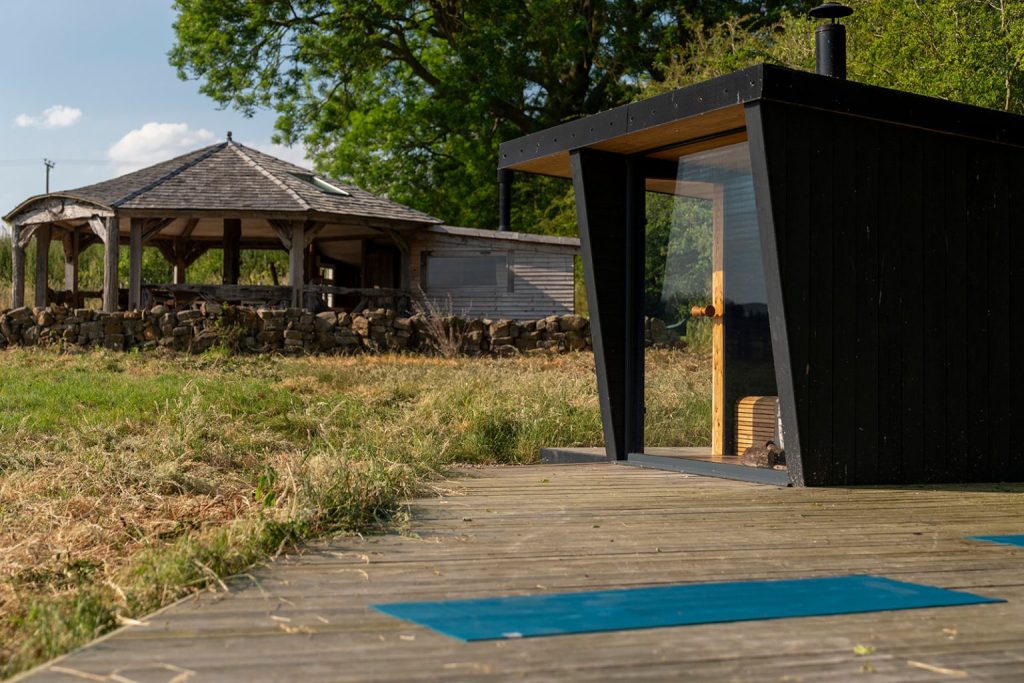
Cowslip Meadows is a peaceful retreat setting around 25 minutes from Rugby. Far enough away to feel like a proper escape. Close enough that the journey does not become another thing to organise.
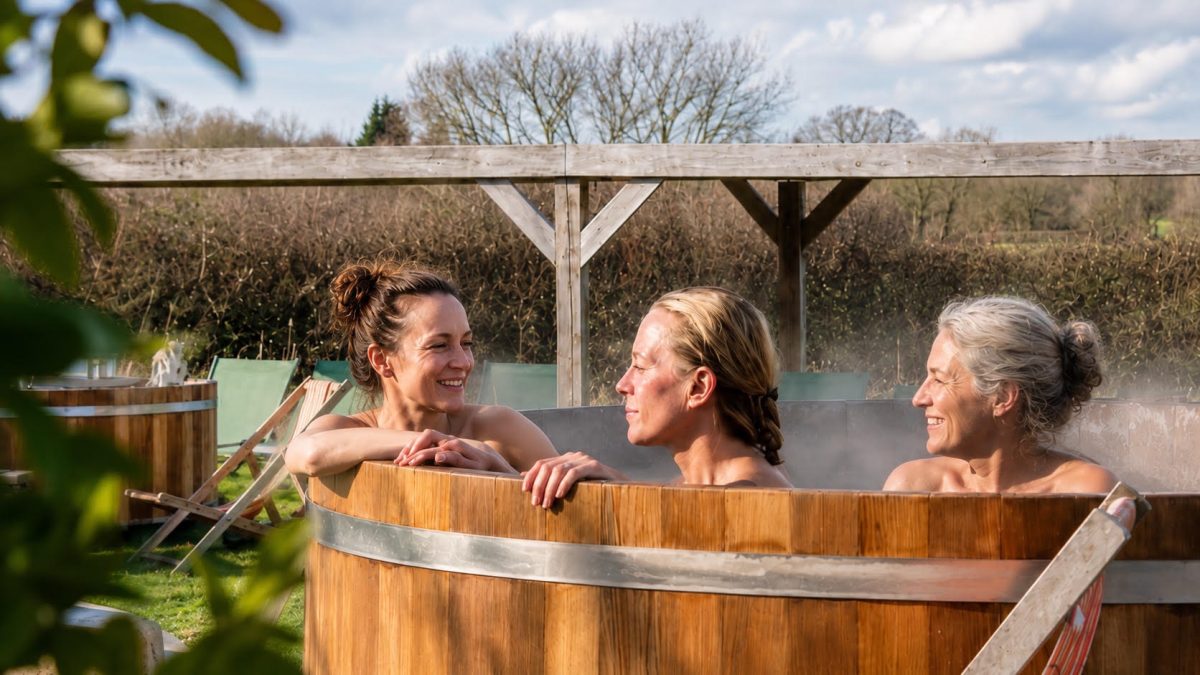
You’ll have time to enjoy the grounds, walk to the lake, wander outside, or use the optional sauna. It is the kind of place that helps you start to exhale the moment you arrive.
What the day looks like
You’ll arrive to a smoothie and a light snack, and from there we ease in slowly. There is nothing to prove and nowhere to rush to.
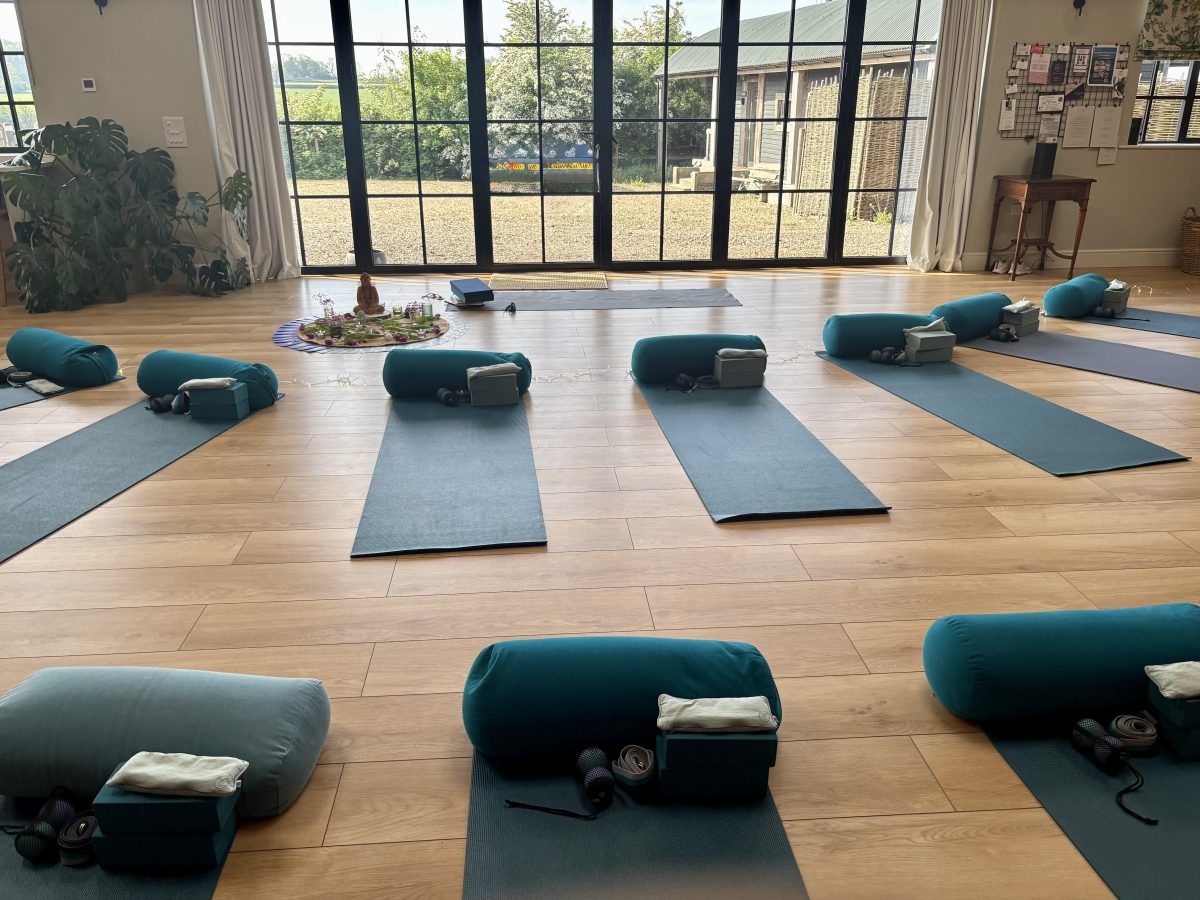
The morning will include breathwork, meditation, gentle movement and myofascial release to help you arrive fully, release tension and come back into your body.
Then we’ll move into a Feel Good Flow. Energising and spacious, but always at your own pace.
Leanne from Wild Routes UK will also guide us through a seasonal nature experience, giving you the chance to slow down, connect with the surroundings and experience the landscape in a different way.
After a nourishing lunch, rest, wander, journal, use the sauna, sit by the lake, chat, or simply do nothing for a little while.
Later in the day, we’ll close with Deep Stretch Yin, Restorative Yoga and Yoga Nidra. The kind of deep rest your nervous system will genuinely thank you for.
You’ll leave feeling lighter. Softer. More settled. Like you have given yourself something you really needed.
Everything included
• Yoga, breathwork and meditation • Myofascial release, Deep Stretch Yin, Restorative Yoga and Yoga Nidra • Seasonal nature connection experience with Leanne from Wild Routes UK. • Nourishing food, tea and cake from Nev’s Kitchen • Optional outdoor sauna • Time to enjoy the beautiful grounds • A mini goody bag to take home • All equipment provided, so just bring yourself
This retreat is for you if…
You’ve been going at full pace and you know it.
You are not completely burnt out, but you can feel yourself heading that way.
You want a day that is genuinely restoring. A day that gives you space to breathe, move, rest and feel cared for.
You do not need to be experienced. You do not need to be flexible. You do not need to be anything in particular.
You just need to want to feel better.
No pretence. No performing.
Just a deeply nourishing day to step away from it all and come back to yourself.
Release + Replenish: Autumn Yoga Day Retreat Sunday 11 October 2026 10am to 5pm Cowslip Meadows, LE17 6QF £115
We are in the middle of a heatwave here in the UK, and you may be finding it hard to cool down. The nights are warm, the rooms stay stuffy, and by the time you come to your mat everything feels a bit different to usual. Sticky before you have even started. Heavy. The idea of lying on the floor for an hour sounds either completely perfect or completely wrong, depending on the day.
So should you do Yin Yoga when it is hot?
Yes. But gently, and with a bit more awareness than usual.
What the Heat Is Actually Doing
In Yin, we are not working the muscles in the same way as a flow class. We are holding for longer, letting the muscles settle and soften, and waiting for the deeper layers of the body to respond, including the fascia, ligaments and tissue around the joints. It is slow, quiet work.
Heat makes that tissue more pliable. Things release more readily. You may feel more open and more spacious in the pose. That can feel really good.
It can also be a bit misleading.
When the body is warm, it is easier to go further into a shape than you normally would, and harder to notice that you have done too much until later. The usual signals can feel quieter. You feel fine at the time, and then the next morning you know.
So in hot weather, going a little less far than you could is not a limitation. It is just good sense.
A useful check: can you breathe here? Can you soften? Could you stay for another minute without bracing or waiting for it to end?
If not, come up a little.
Why Yin Can Work Really Well in Summer
There is something quite natural about slowing down when it is hot. The body is already asking for less. Less effort, less rushing, less doing. Yin meets that well.
A gentle Yin practice in warm weather can feel genuinely settling. You are close to the ground, you are not generating more heat, and you are giving the body time and space rather than asking it to work.
For a lot of people, it feels like relief. A chance to stop. A chance to breathe.
The warmth is doing some of the softening for you. Which means you do not need to add effort on top of it.
How to Adapt
If I am teaching on a warm day, I keep things quieter than usual. Fewer poses, a bit less time in each one, more support, more space between sides.
I choose shapes that feel genuinely restful rather than anything too intense. Supported child’s pose, half butterfly, reclined butterfly, a gentle twist. Nothing that is going to ask too much of a body that is already working hard to stay cool.
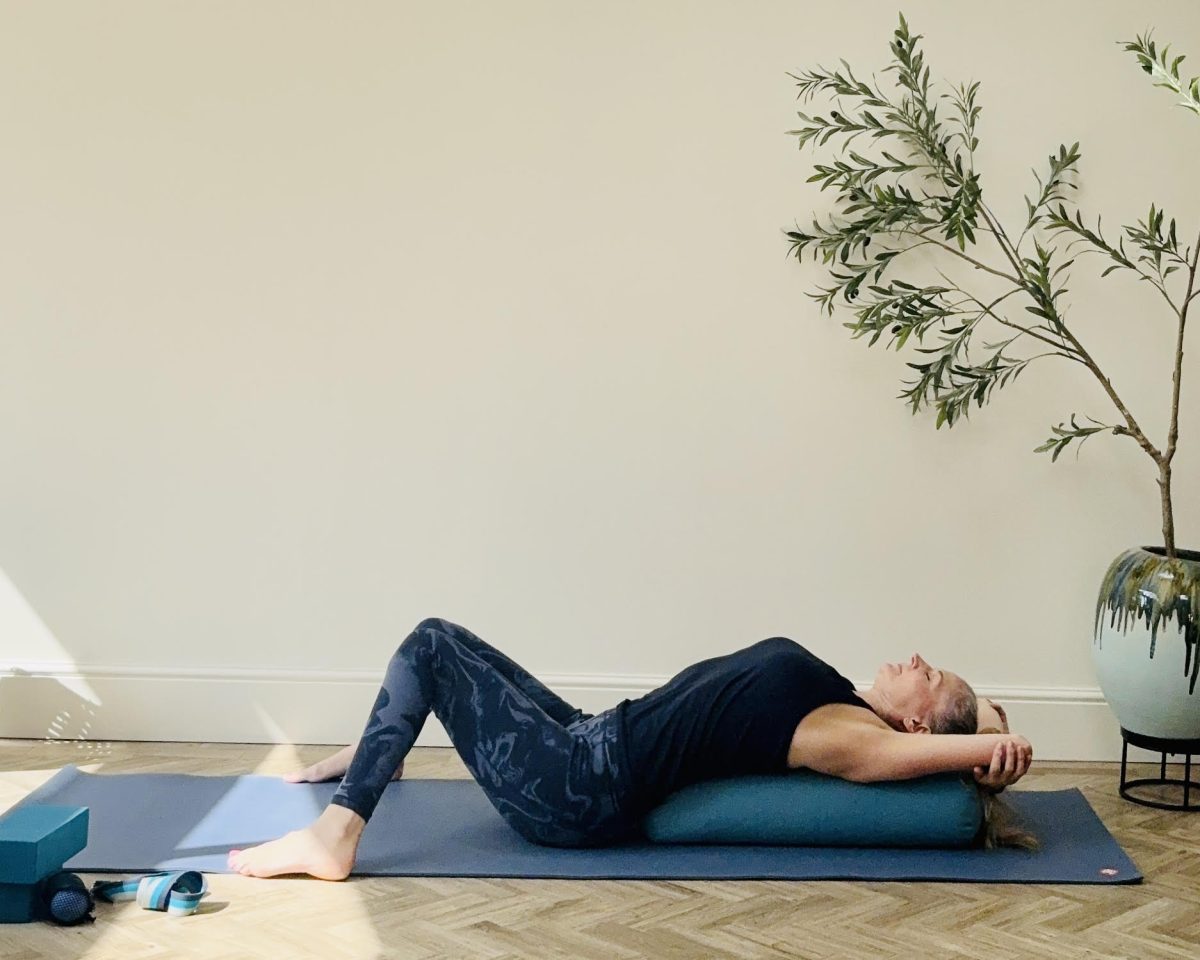
Props help more than usual. A bolster, blocks, a folded blanket under the hips. They let you settle into the pose without sinking too deep or hanging off your joints.
Using more support does not make the practice weaker. It makes it appropriate for the conditions.
Drink water before you come. And if you are practising at home, get some air moving through the room.
When to Skip It
Some days Yin is not the right call.
If you feel dizzy, headachy, unusually tired, or have been out in strong sun for a while, the most useful thing is probably to cool down, drink something and rest.
That is listening to your body, which is exactly what Yin is trying to teach you.
If you are pregnant, unwell, or managing a health condition that affects how you respond to heat, keep things gentle and take medical advice if you need to.
Go gently. Use more support. Come out slowly. Let the practice meet the day you are actually in.
I’ve just got back from a few days in Wales, and it reminded me of something I think a lot of us quietly experience but don’t always talk about.
You finally get away. You leave the usual routine behind. You arrive somewhere peaceful, with fresh air, beautiful scenery, and a slower pace of life, and you tell yourself: right, now I can relax.